
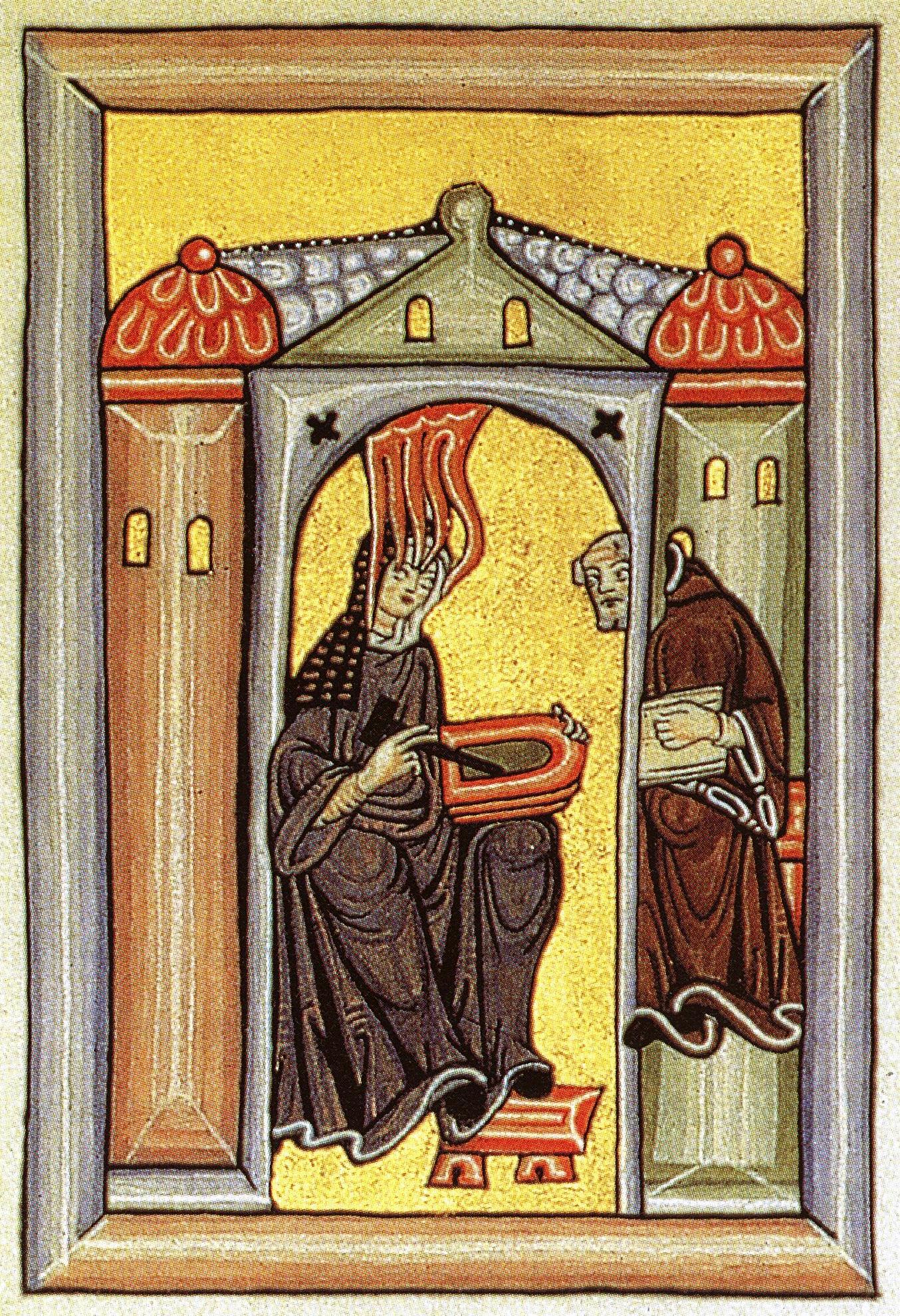

In the best-known picture of Hildegard of Bingen she sits in a small cell with a writing tablet on her knee while tongues of red flame pour through the roof onto her head. A monk leans in through the wall beside her, apparently trying to see what she sees. The image opens the illuminated manuscript of her first book, and it makes a claim that she repeated for the rest of her life: she was not the author. She was taking dictation.
That claim carried a twelfth-century nun with no formal schooling into correspondence with popes and emperors, onto preaching platforms where women did not stand, and, 833 years after her death, into the short list of the Catholic Church's official teachers.
A child given to the church
Hildegard was born in 1098 at Bermersheim, near Alzey in the Rhineland, to a noble landowning couple named Hildebert and Mechthild. She is routinely described as their tenth child, handed to the church as a tithe. It is a tidy story, though the records name only seven older siblings.
By her own later account, the visions began when she was about three. At around eight she was placed with Jutta of Sponheim, a noblewoman living as a recluse beside the Benedictine monastery of Disibodenberg. The sources do not agree on what happened next. Pope Benedict XVI's 2012 apostolic letter has her received as an oblate at eight and professed in 1115, other accounts put her vows at 1112 or 1113, and the difference probably reflects a gap between being handed over and being formally enclosed. When Jutta died in 1136, the women who had gathered around her elected Hildegard to lead them.
She had said almost nothing about her visions for nearly four decades.
The command to write
In 1141, at the age of 42, she experienced what she described as an order from heaven to write down what she saw. With the monk Volmar acting as secretary and editor, she spent the next ten years on Scivias, a book of 26 visions arranged in three parts, finished in 1151.
A woman claiming direct revelation needed cover, and she got it. Bernard of Clairvaux, the most influential churchman of the age, encouraged her. Pope Eugenius III, in the region for a synod at Trier that ran from late 1147 into early 1148, gave her writings his blessing. The apostolic letter says he authorized her to write and to speak in public.
Papal approval changed what she could do. Around 1150 she moved her community of about twenty nuns to a new house at Rupertsberg, near Bingen, over the objections of the abbot of Disibodenberg. He gave way, according to her biographers, after Hildegard was struck with a paralyzing illness that everyone concerned read as divine displeasure. In 1165 she founded a second house across the Rhine at Eibingen.
Songs, remedies and a private language
The visionary books are only part of the output. Hildegard left 69 musical compositions, each set to her own text, one of the largest bodies of work attributed to any medieval composer. Her Ordo Virtutum, written around 1151, is a sung drama in which the Virtues contend for a human soul, and it is usually called the earliest surviving musical drama not attached to a liturgy.
Between 1151 and 1158 she also wrote two works on nature and medicine. Physica runs through the medicinal uses of plants, stones, fish and animals in nine books. Causae et Curae deals with the body and its ailments. Both rest on the idea that health is a balance of hot, cold, wet and dry, and on her notion of viriditas, the greening force she thought animated living things. As a profile of her medicine in Hektoen International points out, these books make no claim to supernatural origin. The modern wellness trade that sells remedies under her name tends to skip that point, and also the fact that her pharmacology is that of the twelfth century.
Stranger still is the Lingua Ignota, a list of roughly a thousand invented nouns with an invented alphabet to write them in. It has no verbs or other parts of speech, so it is a vocabulary and not a language anyone could speak. Nobody knows what it was for.
She also wrote letters, of which about 400 survive, and in the 1160s and 1170s she made four preaching tours. The apostolic letter lists Cologne, Trier, Liège, Mainz, Metz, Bamberg and Würzburg among her stops. Her favorite subject was the corruption of the clergy, delivered to the clergy.
Silenced at eighty
The last fight of her life was over a corpse. In 1178 the nuns of Rupertsberg buried a nobleman who had once been excommunicated. The prelates of Mainz ordered the body dug up. Hildegard refused, insisting that he had confessed and received the last sacraments before he died.
The prelates responded with an interdict. The community could not hear mass, take communion or sing the divine office, which for this abbess was the sharpest penalty available. Her letter of protest is a short theology of music: Adam had an angelic voice before the fall, singing recovers something of it, and those who silence a church without good cause will answer for it. The archbishop eventually lifted the ban. Hildegard died on September 17, 1179, aged 81.
The migraine theory
In November 1913 the historian of medicine Charles Singer told the Royal Society of Medicine that he could name what Hildegard had seen. He had examined the illuminated Scivias at Wiesbaden, and its showers of stars, shimmering lights and crenellated outlines reminded him of what migraine patients report during the visual aura. He published the argument in full in 1917. Oliver Sacks took it up in his 1970 book Migraine, calling the visions "indisputably migrainous," and the diagnosis has been repeated as settled fact ever since.
It is not settled. The neurologist Peter Koehler, reviewing the case for World Neurology in 2021, notes that Hildegard never reported headaches, though her own medical writing discusses migraine, that her descriptions are too detailed for an aura, and that many of the 35 illuminations show nothing of the kind while the same few are reprinted. The historian Katherine Foxhall, writing in the journal Medical History in 2014, adds that the theory depends on Hildegard having designed the pictures herself, which is assumed more often than shown, and that Singer in the same breath suggested hystero-epilepsy, a diagnosis nobody now uses. Hildegard told a correspondent that she saw these things wide awake, with her eyes open, and never lost consciousness.
Migraine remains possible. It cannot be demonstrated from paintings, and it would not explain the books.
A saint, eventually
Rome opened canonization proceedings and never finished them, despite four attempts. For centuries she was a saint by local custom only. Benedict XVI closed the file in 2012, extending her veneration to the whole church on May 10 by what is called equivalent canonization, and declaring her a Doctor of the Church on October 7.
The manuscript that started Singer's theory did not live to see it. Sent from Wiesbaden to Dresden for safekeeping in 1945, it vanished. The flames over Hildegard's head are known today because a facsimile had been painted by hand in the 1920s.