
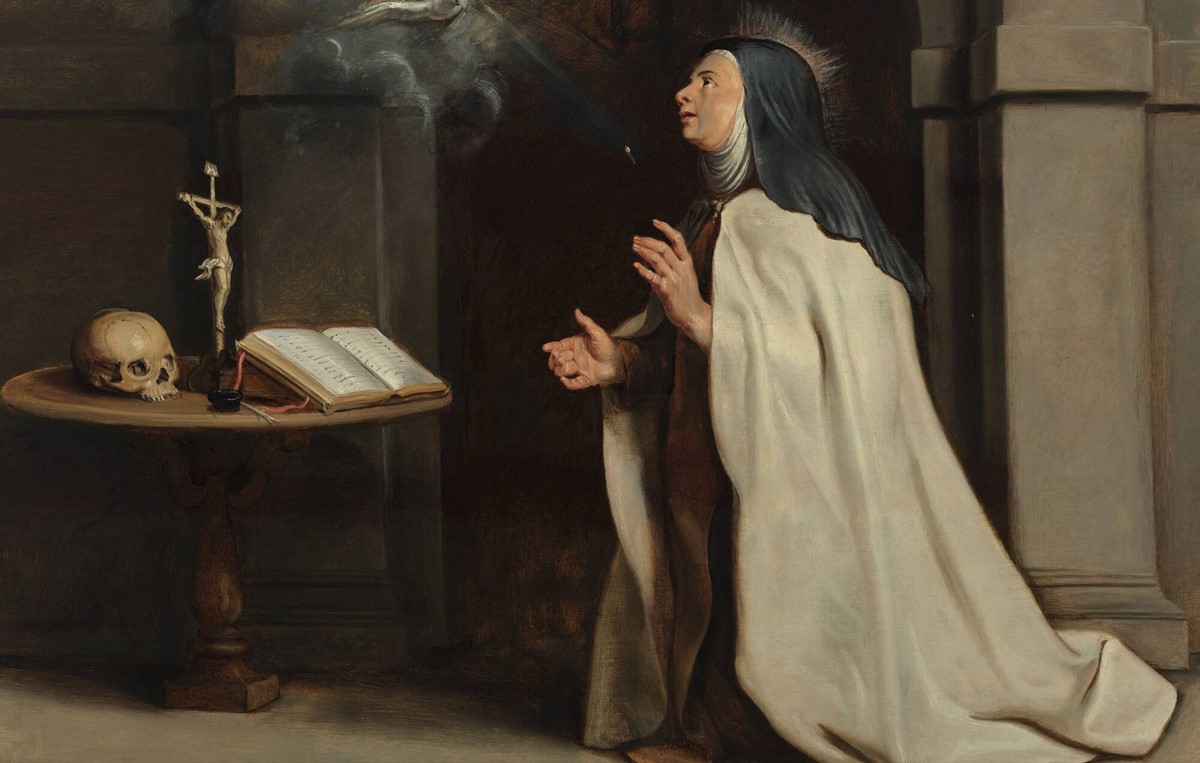

Teresa of Ávila died at Alba de Tormes in 1582, just as Catholic Europe was cutting ten days out of its calendar. The move to the Gregorian calendar deleted October 5 to 14, so the day after October 4 became October 15. The Catholic Encyclopedia of 1912 places her death on the 4th; a papal audience in 2011 put it on the night of the 15th. The church settled the practical question when it canonized her in 1622 and fixed her feast on October 15.
Five years earlier, with her reform under attack from inside her own order, she wrote the book that keeps her name alive well beyond Catholic devotion. It rests on one image: the soul as a castle of seven sets of rooms, with God in the innermost.
A merchant's daughter
Teresa Sánchez de Cepeda Dávila y Ahumada was born on March 28, 1515, in Ávila or the nearby village of Gotarrendura. Her paternal grandfather was a converso, a Jewish convert to Christianity, and was condemned by the Inquisition for allegedly returning to Judaism. Her father, Alonso, became a prosperous wool merchant, bought a knighthood and assimilated into Christian society. A 2025 study in the journal Religions traces how this descendant of conversos was later turned into a national icon, adopted in the 1930s by the women's section of the Falange and hailed as the "Santa de la Raza."
As a child she and her brother Rodrigo set out for the land of the Moors hoping to be martyred; an uncle caught them on the bridge over the Adaja. Against her father's wishes she entered the Carmelite Convent of the Incarnation in Ávila; the Catholic Encyclopedia gives November 1535, Britannica says probably 1535, and other accounts say 1534.
The grave dug too early
After her profession she fell gravely ill. According to the 18th-century hagiographer Alban Butler, in August 1537 she lay for nearly four days in a coma. A grave was dug for her in the convent, and only her father's insistence that he could still see signs of life kept her out of it. She remained a cripple for close to three years.
During that illness an uncle gave her Osuna's Third Spiritual Alphabet, a 1527 guide to the prayer of recollection, and she taught herself mental prayer from it. Then she drifted, receiving visitors at the convent grille and by her own account spending nearly two decades divided between God and the parlor. The turning point came in her late thirties, in front of an image of the wounded Christ. Benedict XVI dated it to Lent 1554 and called it a statue; Butler calls it a picture; Britannica dates her awakening to 1555.
Visions, and the fear of being fooled
She described "intellectual visions and locutions," which the Catholic Encyclopedia explains as experiences in which the outward senses played no part. Confessors and pious laymen suspected the devil, and the same source records that the whole city of Ávila was "troubled by the reports of the visions of this nun." Around 1556 friends warned her the experiences might be diabolical; the Jesuit Francis Borgia reassured her.
The best known vision is the transverberation. An angel, she wrote, held "a long spear of gold" with fire at its tip, and drove it into her heart, leaving pain and sweetness so mixed that she did not want it to stop. Bernini turned the passage into the marble group in Santa Maria della Vittoria in Rome that many viewers find frankly erotic. She also reported being raised off the ground in prayer against her will, and asked her sisters to hold her down.
All of this rests on her testimony and that of people who revered her. Some modern writers have speculated about temporal lobe epilepsy, a diagnosis that cannot be tested on a woman dead since 1582. The firmer historical point is that Teresa herself took the possibility of self-deception seriously, consulted widely, and wrote her autobiography partly as a defense of those experiences.
The barefoot reform
On August 24, 1562, she opened the small convent of St. Joseph in Ávila under a stricter rule, without endowment, living on alms, to local outrage. In 1567 the Carmelite general approved the reform and authorized more houses, and that year she met the young friar later known as John of the Cross, who extended it to men. Benedict XVI counted 17 convents founded in all.
In 1576 the older branch of the order struck back. A general chapter at Piacenza banned new reformed foundations and sent her into retirement at Toledo. In 1577 John of the Cross was jailed in Toledo. Relief came through Philip II: in 1579 cases before the Inquisition against her and her ally Jerónimo Gracián were dropped, and on June 22, 1580, the Discalced province was formally established.
Seven dwelling places
The Interior Castle, in Spanish El Castillo Interior or Las Moradas, The Mansions, was written in 1577, in the middle of that storm, and published in 1588, six years after her death. The origin story usually told is that God showed her the soul as "a most beautiful crystal globe" shaped like a castle, with seven mansions and the King of Glory in the innermost, the light growing stronger toward the center and the outside crawling with toads and vipers. That account comes from a former confessor, recorded as Fray Diego, not from her own pages.
The book itself is a map of prayer. The first three mansions describe the soul's own effort: turning toward God in humility, persisting in daily prayer, living an upright life. In the fourth the initiative passes to God, and the prayer of quiet begins. The fifth is the prayer of union; the sixth, a betrothal full of favors and afflictions; the seventh, spiritual marriage. Along the way she introduces the silkworm reborn as a butterfly, and she borrows the bride and bridegroom of the Song of Songs for the final room.
Her autobiography had described four degrees of prayer; the Castle stretches that ladder into a building. The Catholic Encyclopedia's verdict still fits: she is intensely personal, "her system going exactly as far as her experiences" and no further.
Descartes, Franco and a finger
The Columbia philosopher Christia Mercer has argued in the journal Philosophical Studies that René Descartes borrowed from the Castle, pointing to its insistence on long introspection to strip away bias. "Key components of crucial arguments in the works are the same," she told Columbia Magazine. Descartes never mentions Teresa in his works or letters, and Mercer concedes that whether he read her cannot be known for sure. It is a serious case for influence, not proof of it.
In 1970 Paul VI made Teresa a Doctor of the Church, the first woman given the title. Her body had a stranger career. Nine months after her death the coffin was opened and a hand was cut off and sent to Ávila. Gracián removed its little finger and, by his own account, had to ransom it from Barbary corsairs with a few rings and 20 reales. Her left hand was captured from Republican troops during the Spanish Civil War and kept by Francisco Franco until his death. The writer who mapped the soul as a series of rooms leading inward to a single center ended up scattered outward across Europe: a foot in Rome, a finger in Paris, a hand in a dictator's keeping.