
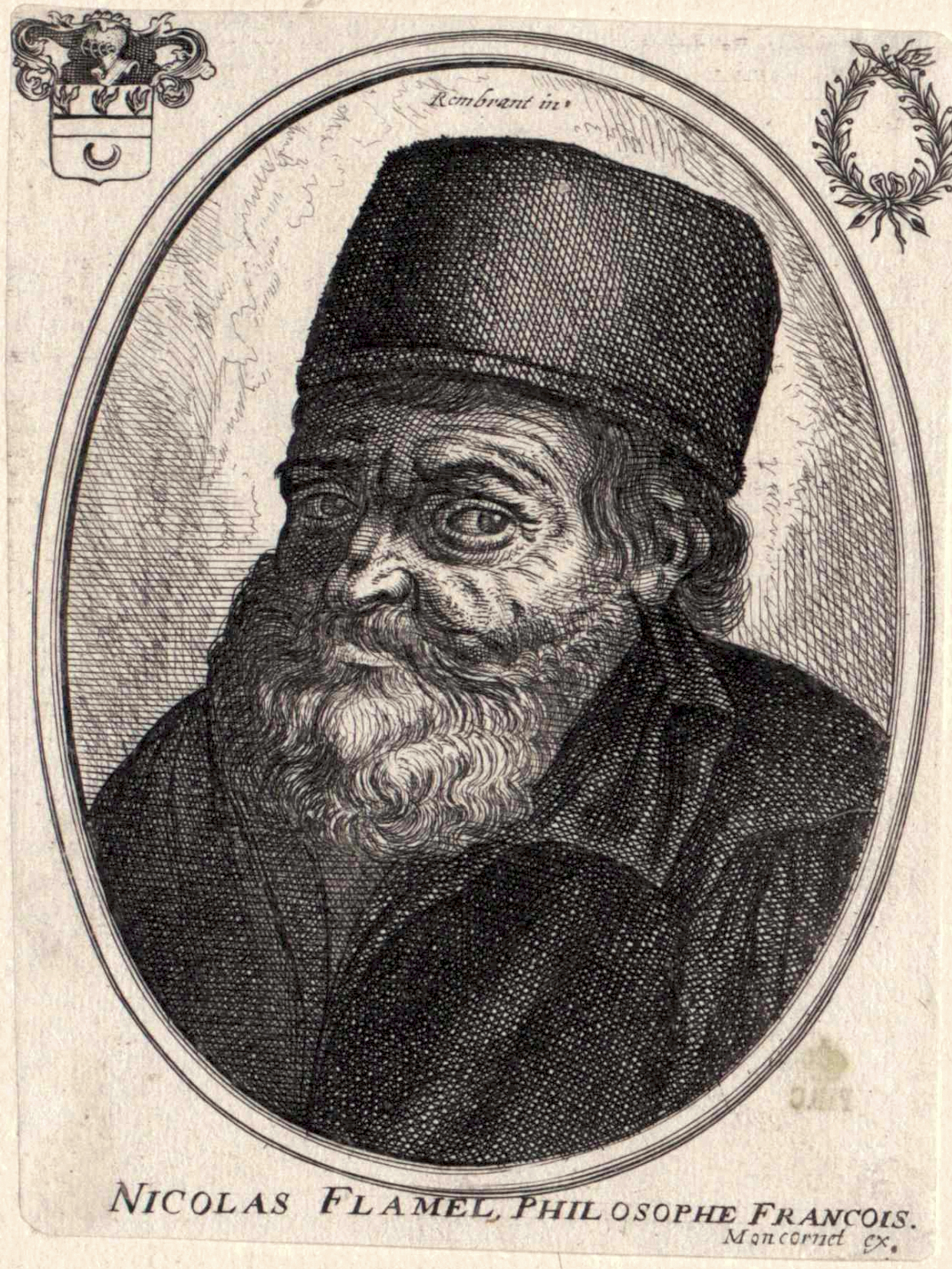

In November 1416, a Parisian scribe named Nicolas Flamel drew up his will. It left money to churches and to the poor, and it shows a generous man, not an extraordinarily rich one. Flamel died on March 22, 1418, and was buried in Paris.
Almost two centuries later, a book printed in Paris gave him a second life. In it, Flamel speaks in the first person about a mysterious manuscript, a pilgrimage to Spain, and the afternoons he and his wife spent making silver and gold. That book made him the most famous alchemist in the Western world. Nearly everything in it was written long after he was dead.
The man in the records
The historical Flamel is well documented, thanks to many surviving records. Born around 1340, he worked as an écrivain public, a writer of contracts, letters and petitions in a city where few people could read or write. He ran two shops, and he and his wife also ran a school that taught the trade. Modern accounts often call him a copyist or a bookseller. The historians Mary and Richard Rouse examined that claim and found it wrong: the few documents that describe him that way are mistaken or later forgeries.
His wife, Perenelle, had outlived two husbands and brought their wealth into the marriage. The wedding date is uncertain; one account gives 1368, another says only that it took place before 1373. They were devout Catholics who owned several properties and paid for religious sculpture, including a carving of the two of them in prayer, financed in 1389, on the portal of the chapel of Saint-Jacques-de-la-Boucherie.
Perenelle died in 1397 and left her husband 5,300 livres tournois. Her sister and brother-in-law contested the bequest in court, and the sister won. In 1407 Flamel completed a house at 51 rue de Montmorency, built to shelter the homeless, and in 1410 he designed his own tombstone, carved with Christ, Saint Peter and Saint Paul. No surviving record connects him with alchemy, pharmacy or medicine.
The book of Abraham the Jew
In 1612 a Paris publisher issued the Livre des figures hiéroglyphiques, which appeared in London in 1624 as the Exposition of the Hieroglyphicall Figures. It claimed to explain paintings Flamel had placed on an arch in the Cemetery of the Innocents. Those paintings had disappeared long before the book came out.
The narrator tells how he bought an old gilded book for two florins. Its cover was brass, its leaves seemed to be bark, and it held three times seven leaves. The first page named its author in gold capitals as Abraham the Jew, "Prince, Priest, Levite, Astrologer, and Philosopher," and cursed any reader who was not a priest or a scribe. Flamel guesses it had been stolen or taken from the Jews. Its pictures showed Mercury with his serpent staff, an old man with a scythe and an hourglass, and the massacre of the innocents.
Keep reading. The rest of this story is free with your email at https://alchemy.expert/articles/nicolas-flamel-scribe-became-alchemist-after-he-died.